Export Functions (Assembly)
STEP
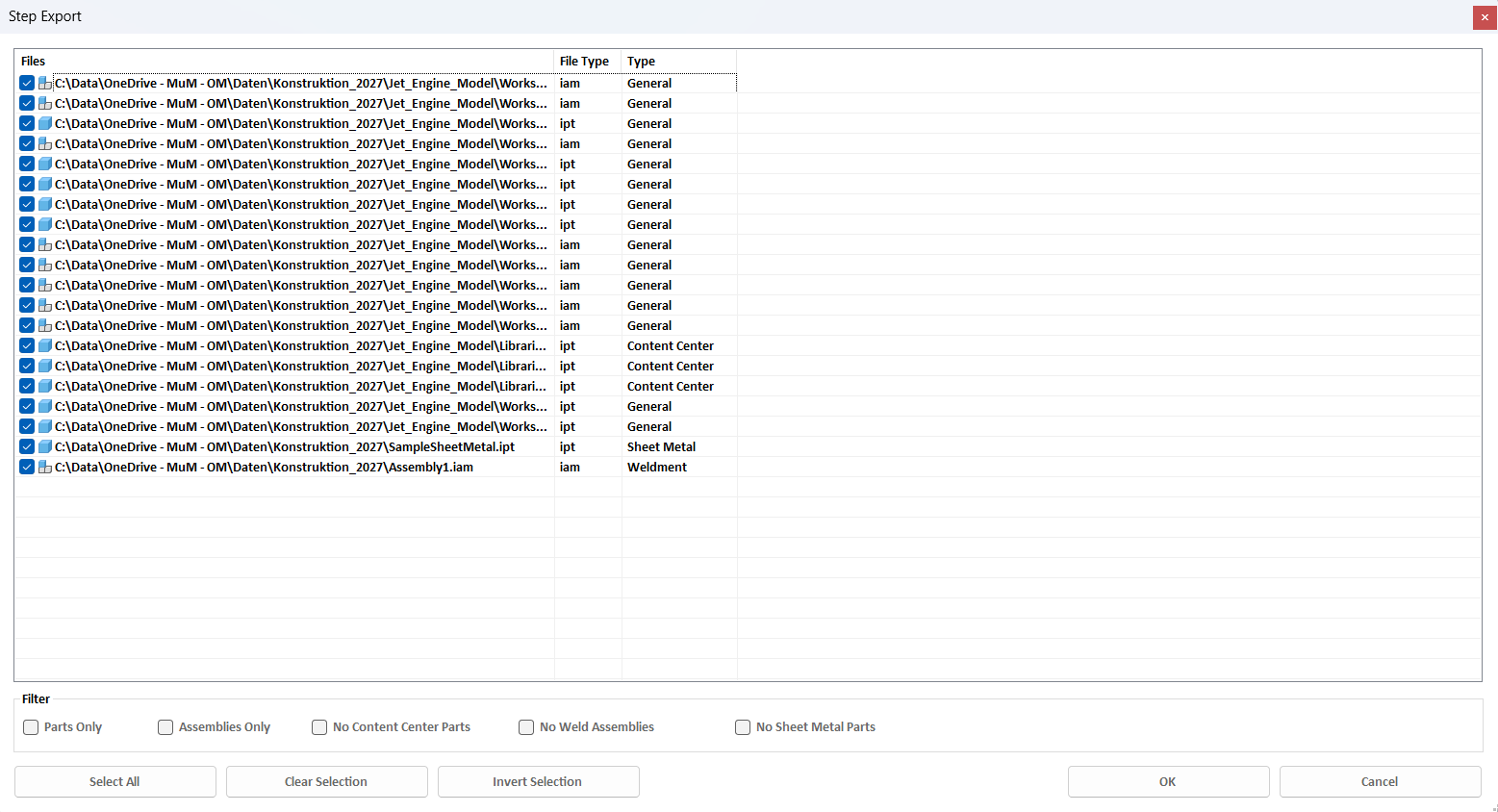
The STEP export function in assembly mode lists all the components and sub-assemblies of the active assembly in a dialog window. The selected files can be exported as STEP files by clicking the "Convert" button.
The program uses the user-defined settings for STEP export. By default, the STEP files are saved under the same file name as the original files. However, with the name generator, you can generate different file names that may include iProperty values from the respective model file. Three separate name configurations can be defined for each file type, and when the "STP 1," "STP 2," or "STP 3" button is clicked, the corresponding configuration will be used.
Files in the list can be selected using the "Select All," "Deselect All," and "Invert Selection" buttons. The list also supports the standard Windows keyboard shortcuts for multiple selection (Shift + Click, Ctrl + Click, Ctrl + A).
In addition to the file name, the list shows the columns File Type (ipt or iam) and Type. The type classifies each file as General, Sheet Metal, Weldment, or Content Center.
Filter
The Filter group can be used to narrow down the list:
- Parts Only / Assemblies Only: Shows only parts or only assemblies.
- No Content Center Parts: Hides Content Center parts.
- No Weld Assemblies: Hides weldment assemblies.
- No Sheet Metal Parts: Hides sheet metal parts.
The filters are applied to the list immediately; hidden files are not exported when converting.
Canceling the export
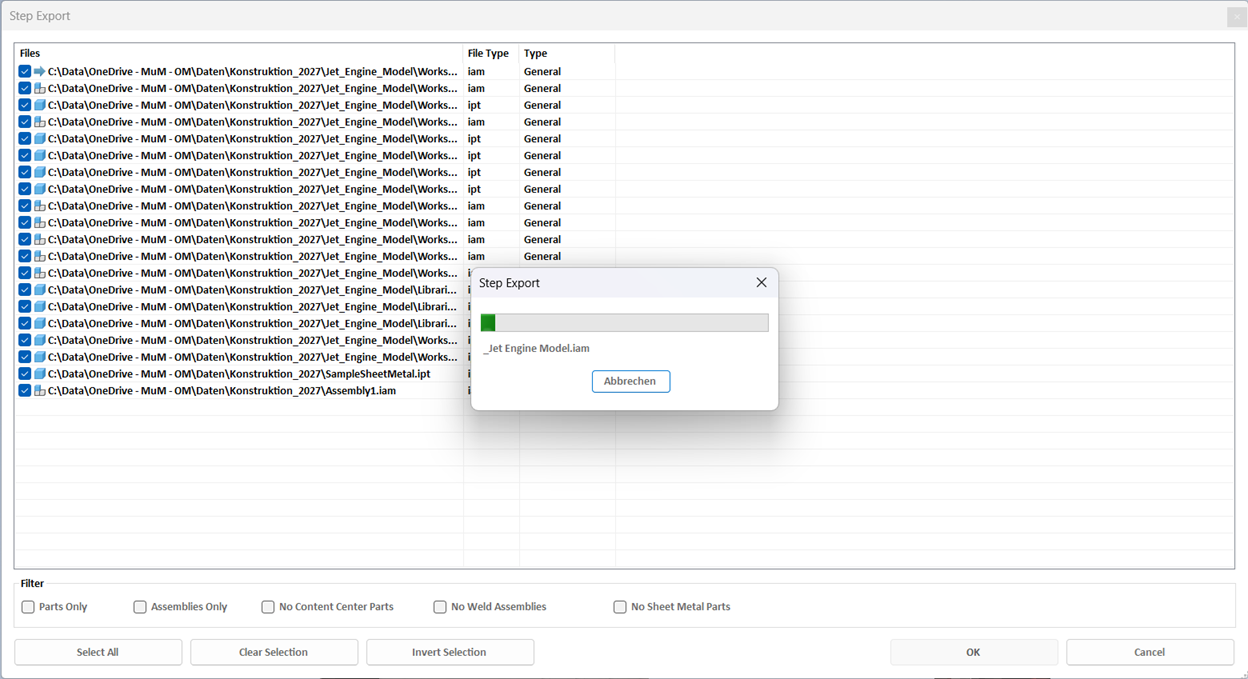
While exporting, a progress dialog shows the file currently being exported and the overall progress. Clicking Cancel stops the export after the current file; files that were already exported are kept.
The dialog can be closed by clicking "Cancel."
PDF, DWF, DXF
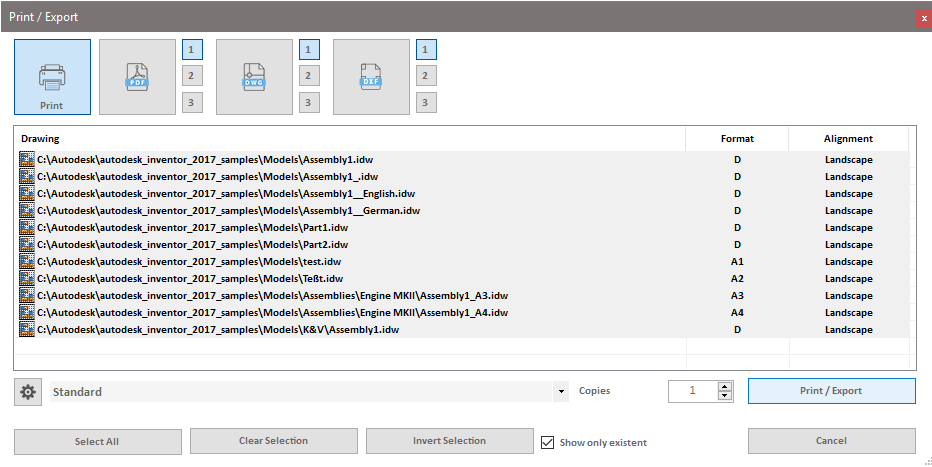
The assembly conversion functions for PDF, DWG, and DXF use the same dialog as the assembly printing function. Multiple export functions can be activated independently. The selected files will be printed and exported to the enabled neutral formats in the same operation.
Three separate name configurations can be defined for each file type. The "1," "2," and "3" buttons next to PDF, DWG, and DXF determine which name configuration will be used.